

Why the finish on a modern Momentum watch is tougher than the plating we used in the 1980s
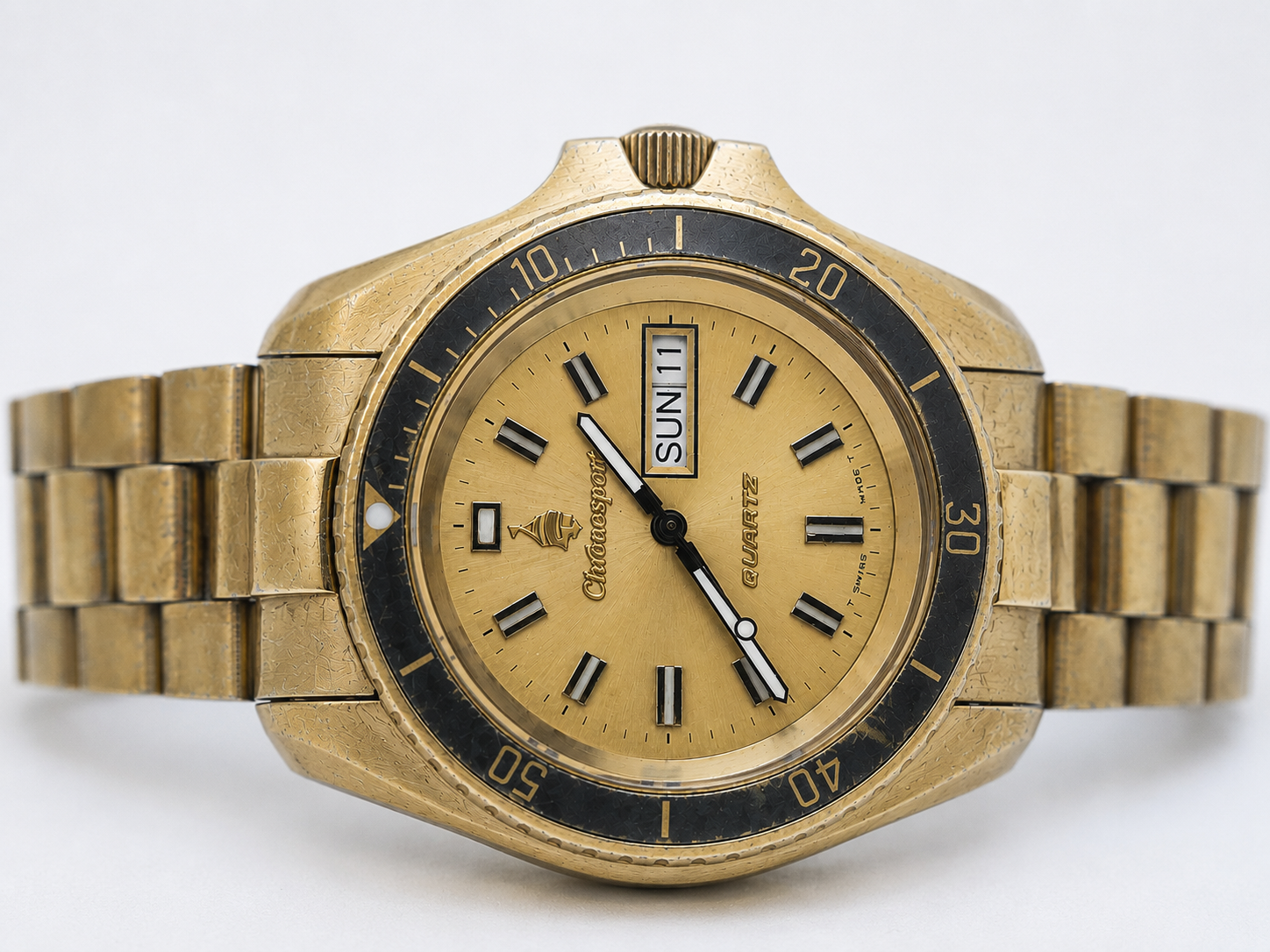
Then and now: The original Champagne Sea Quartz 30 used 20 microns of conventional gold plate. Its modern successor uses ion gold plating — a thinner, harder vacuum-deposited finish designed to resist wear and bond more closely to the steel below.
A finish can tell the history of a watch
When we made the original Champagne Sea Quartz 30 under the Chronosport name, we specified 20 microns of traditional gold plating. That was a serious specification in its day. At a time when many gold-plated watches carried 5 or 10 microns and inexpensive watches were “flash plated” with a very thin layer of gold, 20 microns meant a substantial layer of real gold and a correspondingly higher cost.
It looked beautiful. It was also not permanent.
With enough wear, conventional gold plate gradually rubbed through on the corners, bracelet edges and other high-contact areas. Very thick plating presented a different problem: if the preparation or bonding was less than perfect, the coating could sometimes flake or peel. Thickness helped, but thickness alone could not solve the basic limitations of the process.
Black finishes had similar weaknesses. On watches such as the original Chronosport UDT, black anodizing or black chrome produced the right military look, but the finish could scratch and wear away. Anyone who owns a well-used vintage black watch has probably seen the familiar result: bright metal showing through at the edges and around the pushers.
Today, we have a much better tool for the job: ion plating.
![UDT Black-Ion Arabic Numeral [42mm]](https://momentumwatch.com/cdn/shop/files/udt_lifetyle2.jpg?v=1770423559&width=2283)
![Smokejumper Eclipse Solar [38mm]](https://momentumwatch.com/cdn/shop/files/smoke-eclipse-prod_0000_Layer5.jpg?v=1775670002&width=1096)
How conventional plating works
Traditional electroplating is a wet process. The watch component is immersed in a chemical bath containing dissolved metal ions. An electric current causes the plating metal to build up on the surface.
The method is still useful and can produce an excellent appearance. In traditional gold plating, the thickness is easy to understand and important to service life: more gold generally gives the wearer more material to wear through. That is why the watch industry used to talk so much about 5, 10 or 20 microns.
But a relatively soft coating remains relatively soft, however carefully it is applied. Pure gold is soft, and even the harder gold alloys used for plating are much easier to mark and abrade than modern hard coatings. A thick layer can also develop stresses of its own. If adhesion fails, a thicker deposit does not necessarily fail gracefully.
What happens during ion plating?
Ion plating takes place in a vacuum chamber rather than a liquid bath. The steel cases, bezels, crowns or bracelets are cleaned very carefully and placed inside the chamber. The coating material is turned into a vapour, and some of those atoms are electrically charged — or ionized — to form a plasma.
The watch components are given an electrical bias that draws the energetic ions toward them. Before and during deposition, this ion bombardment helps clean the surface at a microscopic level. It also packs the growing film more densely and helps it bond strongly to the steel below.
The result is a very thin, hard and closely bonded finish. Depending on the colour and performance required, the coating may use compounds such as titanium nitride, titanium carbonitride, chromium nitride or a carbon-based material. Decorative gold-tone systems may also include a final colour layer.
The exact coating stack matters; ‘ion plated’ describes the process, not one universal recipe. That last point is important. Two ion-plated watches need not have identical performance, just as two stainless-steel watches need not have identical machining or finishing. Surface preparation, base layers, coating material, process control and final thickness all make a difference.
Ion plating versus PVD: not really an either/or choice
PVD stands for physical vapour deposition. It is the broad name for a family of processes in which a solid coating material is vaporized in a vacuum and deposited as a thin film. Evaporation, sputtering and cathodic-arc deposition are all forms of PVD. Ion plating is one member of that family.
Its distinguishing feature is energetic ion bombardment of the part before and during deposition. In other words, ion plating is a type of PVD coating.
In the watch business, the labels are often used loosely. A specification may say ‘PVD black’, while another says ‘black IP’. That does not automatically tell you which one is harder or better. To make a fair comparison, you need to know the coating material, the layer structure, the thickness, the preparation and how the finish was tested.
DLC — diamond-like carbon — is another term often seen on black watches. DLC describes a family of carbon-based coatings, not simply a black colour. DLC can also be deposited using PVD or related plasma-assisted processes. Some DLC coatings are extraordinarily hard, but not every black PVD or black ion-plated watch is DLC.
Putting hardness numbers into perspective
Vickers hardness, shown as HV, is measured by pressing a small diamond pyramid into a material and measuring the impression. The higher the number, the harder the surface.
It is a useful comparison, but it needs context: test load, coating thickness, coating composition and the material underneath can all influence the result.
Annealed 316L stainless steel is commonly around 150 to 220 HV, depending on its condition. By comparison, an industrial titanium-nitride PVD coating may be around 2,300 to 2,800 HV. One published decorative DLC system is rated at roughly 3,000 to 5,000 HV.
These are examples from specific industrial coating systems, not hardness claims for every gold or black Momentum case.
The numbers explain why a modern hard coating can resist everyday scuffs far better than old electroplated gold or black chrome. They do not make a watch impossible to scratch. A coating is only a few microns thick, so a hard impact can cut through it or dent the steel underneath. Sand, masonry, tools and metal-on-metal contact can still leave marks.
Hardness improves resistance to scratching and wear; it does not turn a watch case into armour.
Why thin can be better
With old gold plate, greater thickness was often the main route to longer life. Modern hard coatings work differently. Their advantage comes from the combination of hardness, density and adhesion, not simply from piling on more material.
A well-applied ion-plated layer is thin enough to follow the fine brushing, polishing and sharp case lines underneath. Because it bonds so closely to the prepared surface, it is less prone to the peeling associated with some heavy conventional deposits. The hard surface also takes much longer to abrade during normal wear.
There is another practical advantage: ion plating uses only a small quantity of coating material and does not rely on the same kind of chemical bath as traditional electroplating. It is not impact-free — no industrial process is — but it is a highly efficient way to produce a durable decorative surface.
Where you will see it on Momentum watches
The new Momentum UDT uses a black ion-plated finish over its stainless-steel case. It gives the watch the purposeful black appearance associated with the original Chronosport UDT, but with much better resistance to ordinary wear than the black finishes available to us in the 1980s.
We are also bringing back the Champagne Sea Quartz 30. The original Chronosport version wore an unusually generous 20 microns of conventional gold plate. The new model will use modern ion gold plating instead. It keeps the warm champagne character of the vintage watch, while taking advantage of a much harder, more closely bonded modern coating.
Other black-ion Momentum models use the same basic philosophy: start with a strong stainless-steel or titanium watch and apply the colour with a modern vacuum-deposited coating, rather than asking a soft decorative layer to do all the work.
We still expect a watch to record some of the life lived in it. No coloured surface should be sold as indestructible, and a deep enough scratch can mark any coated watch. But compared with the finishes we had available four decades ago, ion plating is a major step forward.
It lets us recreate the look of important Chronosport designs without recreating one of their most obvious limitations.
The short version
Traditional electroplating builds a metal layer in a liquid chemical bath. Its thickness — 5, 10 or 20 microns, for example — was a major part of its durability story.
Ion plating builds a thin, hard film in a vacuum and uses energetic ions to improve cleaning, density and adhesion. PVD is the overall family of vacuum-deposition processes; ion plating is one type of PVD.
The quality of the finished watch depends on more than the label, but a properly specified ion-plated coating is markedly harder and more wear-resistant than the decorative finishes commonly available when the original Champagne Sea Quartz 30 and Chronosport UDT were made.
The colour may be vintage. The coating technology is not.
Technical sources and notes
Hardness figures are illustrative published values for the named materials and coating systems. They should not be read as certified specifications for a Momentum watch unless Momentum publishes a model-specific test result.
- Bodycote, Technical Glossary — electroplating process: https://www.bodycote.com/technical-glossary/
- ScienceDirect, Ion Plating — definition of ion plating as a PVD process: https://www.sciencedirect.com/science/chapter/edited-volume/pii/B9780815520313000065
- Ionbond, Ionbond 01 TiN — 2–4 microns and 2,800 HV: https://www.ionbond.com/coatings/ionbond-01/
- Oerlikon Balzers, BALINIT A — TiN coating properties: https://www.oerlikon.com/balzers/global/en/portfolio/balzers-surface-solutions/pvd-and-pacvd-based-coating-solutions/balinit/tin-based/balinit-a/
- Ionbond, DiamondBlack ADLC — decorative DLC at 3,000–5,000 HV: https://www.ionbond.com/coating-services/decorative/diamondblack-adlc/
- MatWeb, annealed 316L stainless steel — 152 HV example: https://www.matweb.com/search/DataSheet.aspx?MatGUID=530144e2752b47709a58ca8fe0849969

Leave a comment
This site is protected by hCaptcha and the hCaptcha Privacy Policy and Terms of Service apply.